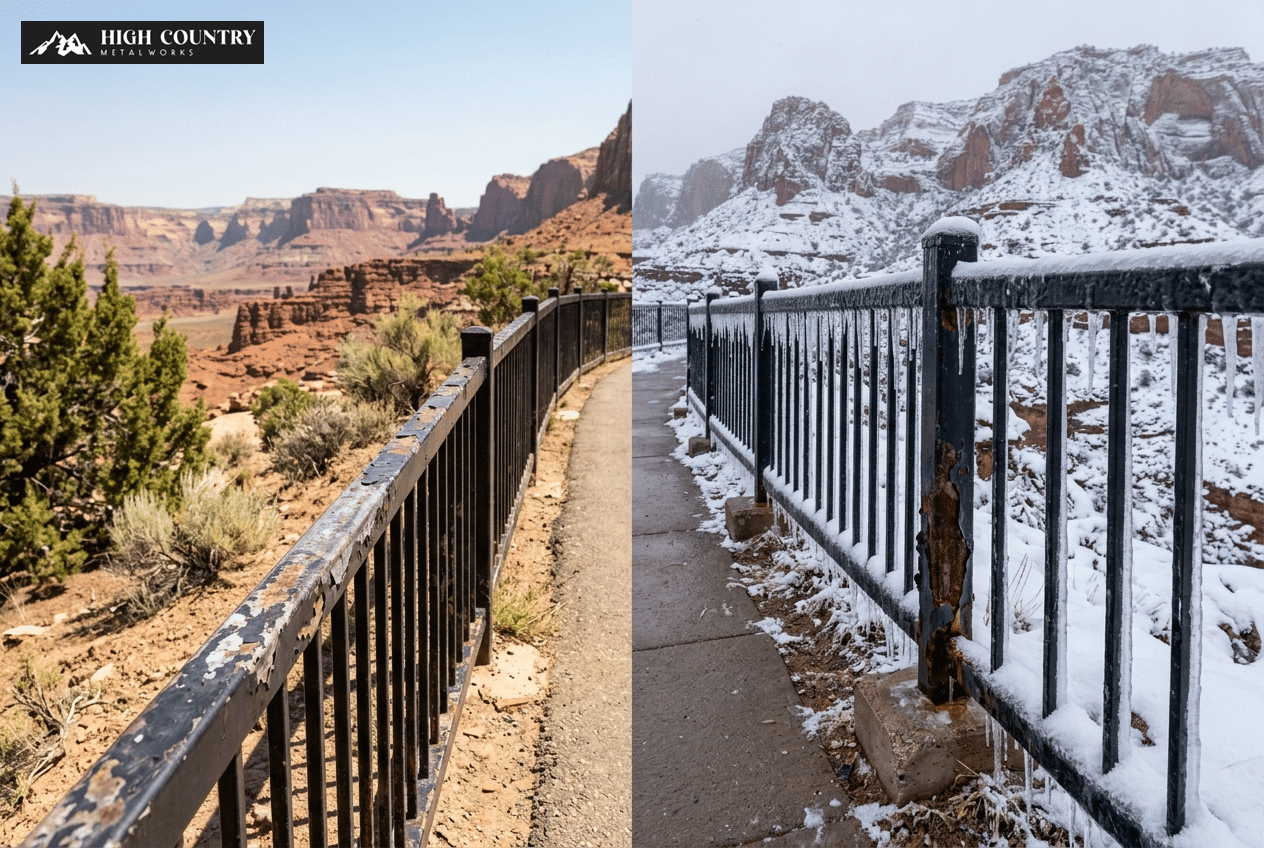
How Extreme Weather Conditions Affect Railing Durability
Extreme weather conditions on railing systems damage metal in four ways: freeze-thaw cycles crack coatings and welds, salt drives corrosion, heat expands joints, and UV radiation fades finishes. Galvanized steel or marine-grade aluminum with a properly prepared powder coat resists all four, and twice-yearly inspections keep small defects from becoming structural failures.
Key Takeaways
Freeze-thaw cycles do their worst damage at coating flaws, weld seams, and post bases, where water collects and expands as ice.
Steel performs best with hot-dip galvanizing under the powder coat. Aluminum and 316 stainless resist rust on their own but still need smart joint design.
Heat is a movement problem. Aluminum expands roughly twice as much as steel, so long runs need room to move.
Two inspections a year and a freshwater rinse after salt season protect the finish at almost no cost.
Railings are the one structural element people lean on during the worst weather of the year. That makes railing durability a safety question before it is an appearance question. A rail that looks flawless in October can carry hairline coating cracks, and by April those cracks are rust.
This guide explains how each weather extreme attacks metal, which outdoor railing materials hold up, and what a fabricator specifies for decks, balconies, and staircases in harsh climates like Utah's mountain communities.
Extreme Weather Conditions on Railing Systems: Four Failure Mechanisms
Freeze-thaw cycles are mechanical, salt is electrochemical, heat is dimensional, and UV is chemical. Treating them separately explains why a railing can survive ten winters and still fail early beside an entry where de-icer gets tracked in.
Freeze-Thaw Railing Damage Starts at the Weld
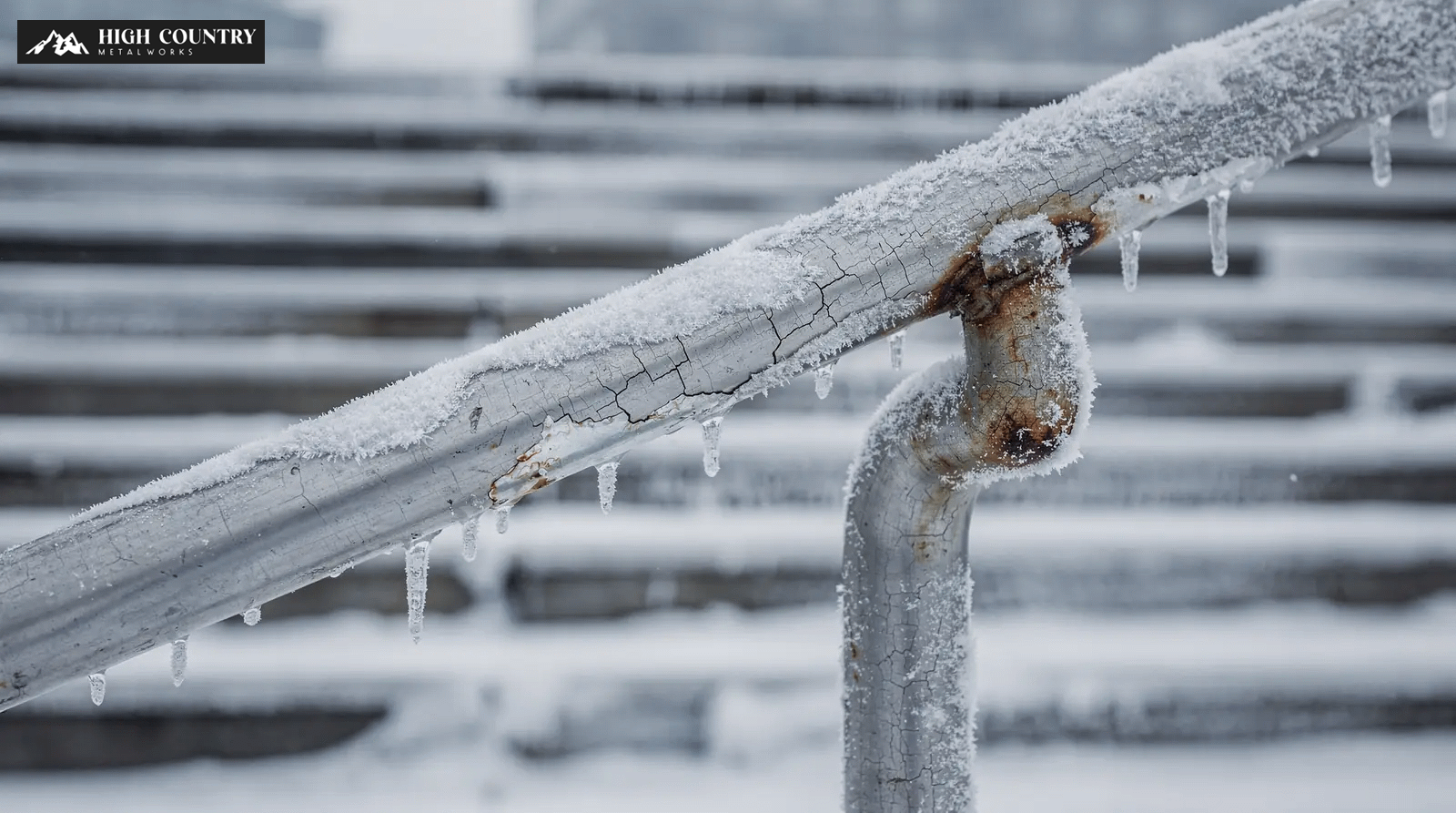
Water enters through chips, pinholes, and unsealed weld seams during warm afternoons. Overnight, it freezes, expands, and lifts the edge of the coating. Repeat that hundreds of times in a single winter and the finish peels back to bare metal. In our shop, the failures we see most often are not mid-span on a straight rail. They start at weld toes, post bases, and any hollow section that can hold water like a cup. Sealed or drain-vented detailing matters more than wall thickness.
Severe cold adds a second problem. Senmit's cold-weather railing analysis reports that structural steel with about 0.2% carbon shows a ductile-to-brittle transition near -4°F, and that minor flaws can become fracture points under sudden loads as temperatures approach -22°F. Aluminum has a different crystal structure and does not show the same sharp transition, which is one reason it is specified for deep-cold exposure.
Salt Accelerates Corrosion on Unprotected Steel
Salt arrives in two ways: coastal spray and de-icing products on roads, driveways, and walkways. Both leave particles that hold moisture against the railing, creating an electrolyte that speeds rust on steel and iron. Rust rarely starts on a flat, intact surface. It starts at fastener heads, cut edges, and scratches near entries where salt is spread.
Aluminum behaves differently. When exposed to moisture, it forms a thin oxide layer that renews itself when scratched, as Wagner's review of aluminum railing performance explains.
One detail most guides skip is galvanic corrosion. Pair stainless fasteners with an aluminum or galvanized post in a wet, salty environment, and the less noble metal corrodes faster around the contact point. Isolating dissimilar metals with nylon washers or sleeves is a small step that prevents a common premature failure.
Heat and UV Attack Finishes and Joints
Sun exposure damages railings in two separate ways. UV radiation breaks down inferior paints, leaving chalking and fading. Heat expands the metal itself. Aluminum expands roughly twice as much as steel per degree of temperature change, so a long aluminum run installed without expansion allowances can stress joints and fasteners over repeated seasons.
A cured powder coat bonds to the metal and resists fading and chalking better than most liquid paints, which is why finish specification matters as much as the base metal.
Outdoor Railing Materials Compared for Harsh Climates
The right choice depends on span length, salt exposure, and budget. This comparison reflects general fabrication practice, and exact performance varies with alloy, coating quality, and installation.
Material | Freeze-thaw | Salt exposure | Heat and UV | Best fit |
|---|---|---|---|---|
Galvanized steel with powder coat | Strong | Strong | Strong | Long spans, stairs, commercial loads |
Powder-coated aluminum | Strong | Very strong | Strong, needs expansion detailing | Decks, balconies, coastal or salted entries |
316 stainless steel | Strong | Very strong | Strong | Premium, high-salt installations |
Painted steel only | Fair | Weak | Fair | Dry, sheltered locations |
Wrought iron | Fair | Weak | Fair | Decorative use with strict upkeep |
Why Steel Still Earns Its Place
Structural steel carries heavy loads, spans farther, and handles cantilevered stairs that aluminum cannot. Its weakness is corrosion, and that is solved with the coating system, not by avoiding steel.
For projects requiring heavy-load support and longer spans, structural steel fabrication provides the foundation for durable metal components and railing systems.
The strongest answer for powder-coated steel railings is a duplex system: hot-dip galvanizing first, powder coating second. The American Galvanizers Association reports that a duplex system can last 1.5 to 2.3 times the combined life of each coating alone, and that the zinc layer extends the powder coat's maintenance cycle by at least 50%. Those figures assume correct surface preparation. Galvanized steel needs different prep than bare steel, and ASTM D7803 covers the process. We tell the galvanizer up front that a powder coat is coming so the zinc surface is handled accordingly.
Where Aluminum Wins
For salt exposure and low maintenance, powder-coated aluminum is hard to beat. It never rusts, and it weighs less. Marine-grade alloys such as 5052 and 6061 are common choices for outdoor work. The trade-offs are expansion, which must be designed for, and lower stiffness, which limits long unsupported spans and heavy-load applications.
What Makes a Railing Weather-Resistant
Weather-resistant railings combine three layers: a base metal suited to the exposure, a protective coating system, and construction details that keep water from collecting. Skip any layer and the railing ages faster than the property owner expects. Many failed railings used good metal and a good coating but poor details.
The details we insist on in the shop:
Drain holes at the low points of hollow sections so water exits instead of freezing inside.
Fully sealed, smooth-ground welds before coating, since crevices trap moisture and pinholes in a coating start at rough weld surfaces.
Radiused edges, because powder coat thins on sharp corners and those corners rust first.
Isolation between dissimilar metals to stop galvanic corrosion.
Slip joints or expansion allowances on long aluminum runs.
When comparing quotes, ask for the finish specification in writing: pretreatment method, coating thickness, and cure schedule. Salt-spray test data under ASTM B117 offers a useful benchmark for corrosion-resistant exterior railings, though lab hours are not a promise of field life. Preparation, not the color of the coating, determines how long it lasts.
Before choosing a fabricator, also review the metal fabrication warranty to understand the importance of workmanship, material specifications, and coverage when investing in custom metalwork.
Railing Maintenance and Protection Through the Seasons
Railing maintenance and protection costs far less than replacement, and most of it takes minutes. A simple annual rhythm covers nearly every property.
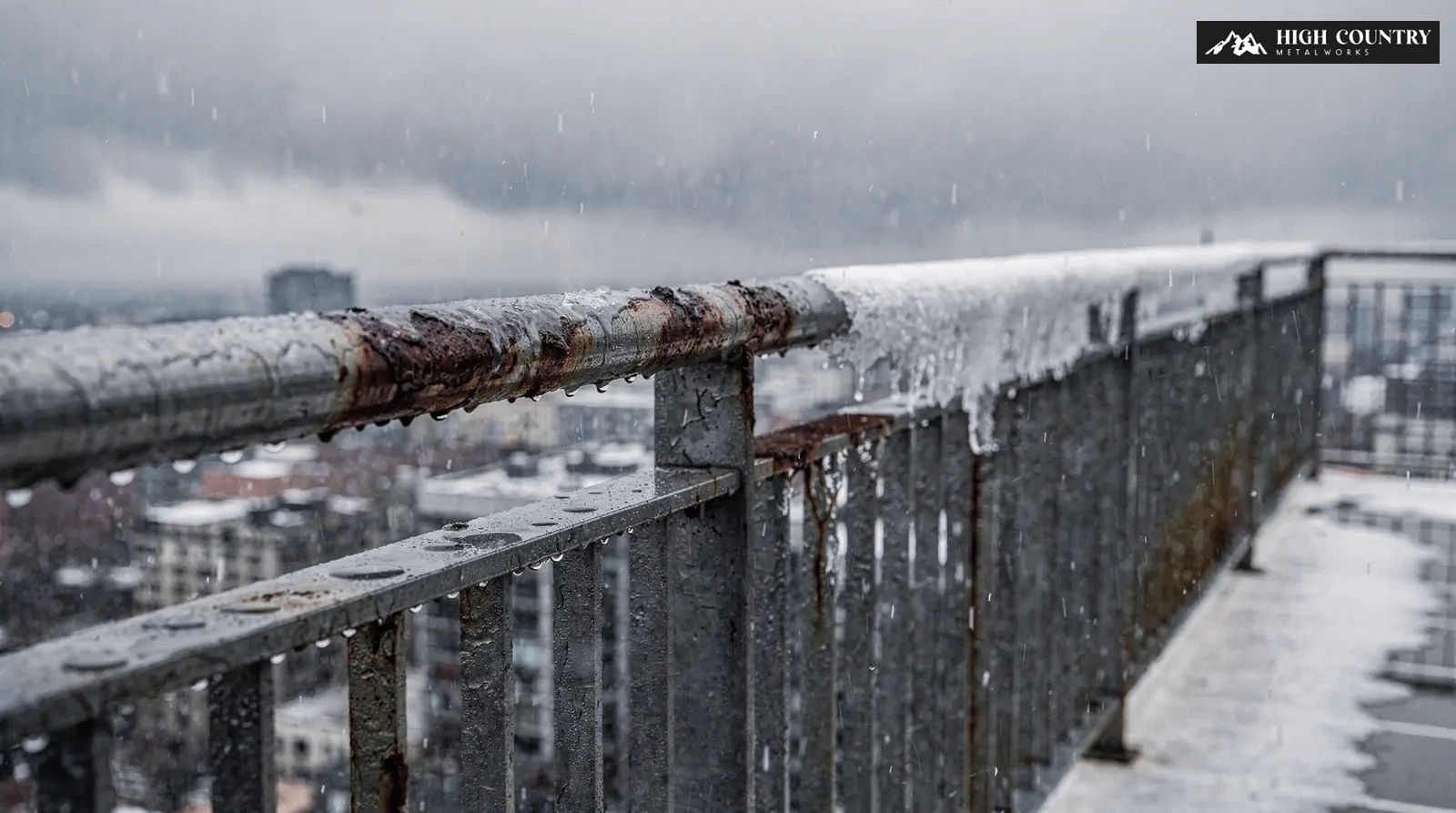
In spring, rinse the railing with fresh water to remove accumulated salt, then inspect every weld, post base, and fastener. Look for bubbling or flaking coating, orange staining around fasteners, and any wobble in posts. Touch up chips with manufacturer-matched coating before moisture gets underneath. In fall, repeat the inspection before the first freeze, because defects found in October are cheap to fix and defects found in March are not.
During winter, damage often comes from tools instead of weather. Shovels and snow blowers chip finish at post bases, and piled snow keeps those bases wet for weeks. Use plastic shovels, push snow parallel to the railing rather than into it, and avoid stacking snow against posts.
Call a fabricator when you see rust bleeding from a weld, cracked weld metal, or a post that moves under hand pressure. Cracked welds need repair before any recoating.
Choosing the Right System for Your Property
Match the system to the exposure. For salted entries, balconies, and coastal installations, powder-coated aluminum or galvanized steel with a powder coat gives the best balance of cost and service life. For long spans, cantilevered stairs, and commercial projects with heavy load requirements, galvanized structural steel is the stronger choice.
When deciding between custom and prefabricated options, consider how each system fits your property's measurements, design requirements, and exposure conditions. Our guide to custom vs. prefab metal railings can help clarify the differences before choosing a railing system.
Property managers should compare lifecycle cost, not just installed price, since a railing recoated every few years often costs more than a duplex system. Always confirm guard height and load requirements with your local building department before finalizing a design.
High Country Metal Works fabricates custom railings for residential and commercial clients, with material and finish selected for the property's actual exposure.
Conclusion
Extreme weather rarely destroys a railing in one event. It works through small, repeated damage at welds, edges, and coating flaws. The properties with the longest-lasting railings choose the right base metal, specify a galvanized or aluminum system with a properly prepared powder coat, and insist on drainage and joint details that keep water out. Add a simple twice-yearly inspection, and a railing can perform for decades instead of seasons.
FAQ
1. How do extreme weather conditions affect metal railing durability?
Freeze-thaw cycles crack coatings, salt accelerates corrosion, heat expands joints, and UV fades finishes. The right metal, galvanizing, and powder coat slow all four.
2. What is the best outdoor railing material for freezing climates?
Powder-coated aluminum and galvanized steel with a powder coat both perform well in freezing climates. Aluminum suits decks and balconies, while galvanized steel suits long spans and heavy loads.
3. Do powder-coated steel railings rust?
They can if the coating is chipped or the steel was poorly prepared. Hot-dip galvanizing under the powder coat greatly reduces that risk.
4. How do freeze-thaw cycles damage metal railings?
Water seeps into coating flaws and weld seams, freezes, and expands. Each cycle widens the gap until the finish peels and bare metal is exposed.
5. How often should outdoor metal railings be inspected?
Inspect twice a year, in spring and fall, and rinse off road salt after winter. Check welds, post bases, and fasteners first.


