Metal Fabrication Warranty and Liability: What to Verify First?
Quick answer: Verify four things in writing before you sign: active state licensing, a current certificate of insurance showing general liability and workers' compensation, written metal fabrication warranty terms covering materials, workmanship, and finish, and contract language that assigns metal fabrication liability. A warranty only pays out if the company behind it is still in business.
Key Takeaways
Warranty and liability protect against different problems: one fixes defective work, the other responds to injury or property damage.
A certificate of insurance proves a policy exists, not that it covers your project. Ask about completed operations and additional insured status.
Length alone says little about a warranty. The remedy, the exclusions, and the finish terms decide what you actually receive.
Utah generally allows six years to bring contract and warranty claims on real property improvements, so keep dated records.
Fabrication is a high-risk trade, which makes compliance history a fair vetting question.
Metal fabrication contracts are where most project disputes begin, and where most can be prevented. This guide covers the licensing, insurance, and quality assurance checks to complete before metal fabrication services start, with Utah-specific details most generic checklists skip. For projects with a fixed installation date, confirm expected metal fabrication lead times early so production and site scheduling are clear before the contract is finalized.
Confirm Five Items Before You Sign
Five items deserve written confirmation before any signature: track record, licensing, insurance, risk allocation, and scope. Skipping this review exposes property owners and general contractors to delays, disputes, and uncovered losses once work begins.
Track record. Ask for completed projects of similar size and material. A shop with 20-plus years of custom metalwork in Utah, like High Country Metal Works, has already met the code and climate problems your project will raise.
Licensing. Confirm the fabricator, and any separate installer, holds the licenses the work requires.
Insurance. Get current proof of general liability and workers' compensation coverage, not a verbal assurance.
Risk allocation. Read the indemnification, waiver, and damage-during-installation clauses. They decide who pays when something goes wrong.
Scope detail. Separate base fabrication from add-ons such as powder coating, glass infill, or site welding, so warranty terms attach to a defined scope. Confirm the expected production schedule and metal fabrication lead times in writing, too.
Company size matters too. High Country Metal Works operates from Provo, Utah, with a team of eight, so the people who quote your job stay close to it.
Warranty and Liability Protect Against Different Problems
Most buyer guides blur these two, and that confusion leads to denied claims. A warranty is the fabricator's written promise to repair or replace defective materials, workmanship, or finish for a stated period. Liability is responsibility for harm the finished work causes to people or property, and an insurer usually pays it, not the warranty.
The difference shows up fast in practice. Powder coating that peels in year three is a warranty claim. A loose baluster that injures a guest is a liability claim. Metal fabrication liability follows the piece through installation, daily use, and years afterward, so your contract should address each protection separately, with its own terms and its own paper trail.
Read the remedy language closely. Many warranties promise to repair or replace at the fabricator's option, and some exclude the labor to remove and reinstall the part. Ask which applies before you sign.
Verify Insurance and Licensing Beyond the Certificate
Read the certificate of insurance for what it leaves out
A certificate of insurance is a snapshot, not a contract. It confirms that policies existed on the day it was issued, but it does not change what those policies cover. Request it directly from the fabricator's insurance broker and check four details:
General liability that includes products and completed operations, which responds to claims after the work is finished.
Workers' compensation covering the crew that will be on your site.
Policy periods that run through the full installation window.
An additional insured endorsement naming you or your general contractor, if your contract requires it.
Insurers treat fabrication and machine shop operations as elevated risk, which is why this paperwork deserves the extra day. Standard general liability typically pays for injury or property damage caused by the work, not for the cost of redoing the defective work itself. That cost belongs to the warranty.
Check licensing with the state, not the shop's website
Utah's Construction Trades Licensing Act requires a Division of Professional Licensing (DOPL) license for construction work above a dollar threshold, and installing railings, staircases, or structural steel on a building can fall under it. Look up the license number through DOPL yourself and confirm the classification matches the work.
For stair projects, it also helps to understand the difference between a handrail and stair railing, since the components may serve different purposes and requirements.
Ask, too, how the shop handles OSHA's welding, cutting, and brazing standards under 29 CFR 1910 Subpart Q. A fabricator who cannot answer introduces risk that eventually lands on the project owner's desk.
Metal Fabrication Warranty Coverage That Holds Up
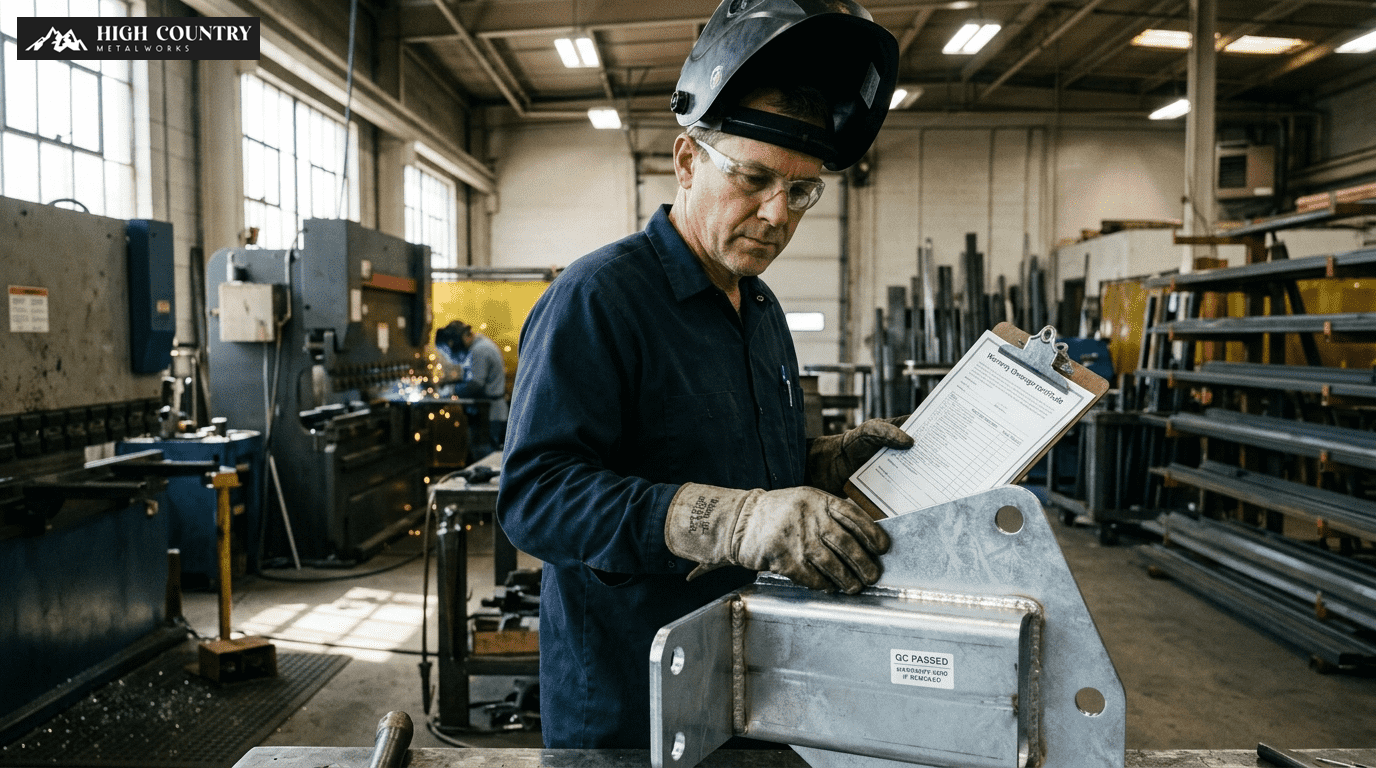
A solid metal fabrication warranty covers three elements: the materials used, the labor performed, and the finish applied to resist corrosion. For each, the written terms should state the coverage length, the exclusions, the remedy, and which company stands behind the promise. Financial stability matters as much as the printed words, because a twenty-year certificate from a closed shop is worthless.
Structural workmanship and materials
Coverage should address welds and connections, plus defects in the steel, aluminum, or wrought iron itself. Do not rank warranties by length alone. Generic buyer guides often cite a one-year baseline, while individual shops advertise ten or twenty years, and neither number means much without the exclusions attached. A shorter warranty with clear remedies beats a long one full of carve-outs.
Finish and corrosion
Finish terms deserve their own paragraph in the contract. Coating warranties in related metal industries often turn on film integrity, meaning the coating stays bonded to the metal, rather than on rust alone. Ask which standard applies to the powder coating, galvanizing, or patina on your project, and request the coating specification in writing. Expect exclusions for de-icing salts, abrasive cleaners, pressure washing, and scratches that expose bare metal.
Installation and transfer rights
Coverage should extend to installation technique when the fabricator installs, since poor installation voids most protection regardless of material grade. If another contractor installs, ask what the warranty requires of them. Confirm that coverage transfers if the property sells, which matters for rental and commercial buildings.
Utah Climate and Claim Deadlines Shape a Warranty's Value
Utah's climate tests every warranty. Freeze-thaw cycles, de-icing salts, intense UV at elevation, and heavy snow loads stress rails, gates, and stair components each winter. In our experience, climate-matched material and coating choices prevent more claims than any clause in a contract.
High-elevation and moisture-heavy sites call for different alloys and finishes than dry installations, and warranty terms should reflect that difference.
Deadlines matter just as much. Utah Code 78B-2-225 generally requires contract and warranty actions on improvements to real property to begin within six years after completion, with a nine-year outer limit that applies only in narrow circumstances.
Give written notice as soon as you see a problem, photograph it with a date, and keep your maintenance log. Most warranties exclude damage tied to neglected upkeep, and that log is your proof.
Quality Assurance Records Back Up Every Promise
Metal fabrication quality assurance starts with a documented inspection process, not a verbal promise. Before handover, ask for records you can file with the contract:
Material certifications for structural steel, which trace the metal to its source.
Weld inspection notes and, for structural work, the welding code the shop follows, such as AWS D1.1.
Footing and anchor details showing posts set in concrete and secured with corrosion-resistant fasteners.
Dated handover photos and a written maintenance schedule, with twice-yearly inspections as a sensible baseline for exterior metalwork.
The same principle applies to other fabricated metal products, including metal planter boxes: confirm the agreed materials, finish, installation responsibilities, and handover documentation are recorded in writing.
These records settle disputes about what was built and when, which is where many denied claims start.
Compliance history belongs in the review, too. The Texas Department of Insurance's workers' compensation division, citing Bureau of Labor Statistics data, reports that more than 16,000 workers are seriously hurt each year in fabricated metal product manufacturing, and that OSHA issued $12.4 million in citations to metal fabrication facilities from October 2022 to September 2023. Repeated citations can signal shutdown and claims risk, and both put a long-term warranty at risk.
Mistakes That Void Warranty or Liability Protection
Most failures trace back to a handful of avoidable decisions. Each one pushes cost and risk back onto the property owner, usually after the damage is done.
Choosing an unstable supplier. Verify how long the fabricator has operated and how it has handled past claims.
Skipping climate maintenance. Missed spring inspections after freeze-thaw cycles are a common reason claims get denied.
Letting others modify the work. Third-party field drilling, welding, or repainting can void coverage on the affected component.
Hiring unlicensed installers. Unlicensed work often fails inspection and can void protection outright.
Ignoring risk clauses. Treating liability as someone else's concern during negotiation leaves gaps nobody budgeted for.
Paying in full before the paperwork. Hold final payment until you have the signed warranty and handover records.
In our experience, the most avoidable denied claim is one where nobody can say when the work was finished or which coating was applied. A single dated handover file prevents it.
Conclusion
A strong warranty starts before the first cut. Verify licensing, read the insurance certificate for what it leaves out, separate warranty terms from liability terms, and collect quality assurance records at handover. Those steps cost a few hours and prevent disputes that cost months. If you are planning custom railings, staircases, or structural steel in Utah, High Country Metal Works can walk you through warranty terms and documentation before you sign.
FAQ
1. What is a metal fabrication warranty?
A metal fabrication warranty is a written promise to repair or replace defective materials, workmanship, or finish for a stated period. It typically excludes damage from misuse, third-party modifications, and neglected maintenance.
2. How long should a metal fabrication warranty last?
Terms range from one year on basic workmanship to ten years or more on structural work or coatings. Compare what each term covers, including remedy and exclusions, rather than the number alone.
3. Does general liability insurance cover defective fabrication work?
General liability typically covers injury or property damage caused by completed work, not the cost of redoing the defective work itself. That cost falls under the warranty, so confirm both in writing.
4. What should metal fabrication contracts say about warranty and liability?
They should state warranty duration, exclusions, remedy, and transfer rights, plus insurance minimums, indemnification terms, and additional insured status.
5. What does metal fabrication quality assurance include?
It includes documented inspections, material certifications, weld inspection records, and installation checks such as footing and fastener details, all delivered at handover.


