7 Best Custom Metal Gate Styles for Driveways & Entryways
The best custom metal gates for most homes are double swing gates, cantilever slide gates, and horizontal slat privacy gates, built in steel, aluminum, or iron. Choose the style first based on driveway width, slope, and privacy needs, then pick the material and finish. Custom metal gates fit openings that stock panels cannot.
Key Takeaways
Gate movement (swing or slide) should be settled before finish or ornament, because slope and clearance limit your options.
Steel maximizes strength, aluminum minimizes maintenance, and iron-look designs deliver traditional detail.
Posts, footings, and hinge capacity cause more gate failures than the gate itself.
Automated gates need operators matched to gate weight and a safety package that meets UL 325.
This guide ranks seven styles for metal gates for driveways and metal gates for entryways, with the practical trade-offs that decide how a gate performs after the first season.
What Defines the Best Custom Metal Gate Styles
Three factors separate a gate that works from one that frustrates: how it moves, how much privacy it gives, and how much weight the posts and hardware must carry. Appearance matters, but it comes after those three.
Homeowners often start with a photo of a gate they love. The photo says nothing about the grade of the driveway, the clearance behind the fence line, or the load a hinge will carry every day for decades. A good custom metal gate starts with the site and ends with the look.
For homeowners considering a fully customized entrance, custom metal fabrication can provide the flexibility needed to create gates around unusual opening dimensions, decorative details, and specific material requirements.
7 Custom Metal Gate Styles Worth Considering
1. Double Swing Gate
Two leaves hinge from posts on opposite sides and meet in the middle. This is the classic answer for wide driveways, because splitting the width in half reduces the weight each hinge carries and the arc each leaf sweeps.
Best for: level or gently sloped entries with room for the leaves to open.
Watch for: the swing path. A rising grade, a planting bed, or deep snow can block a leaf mid-arc. Automated double gates also need an operator for each leaf.
2. Single Swing Gate
One leaf, one hinge line, and the fewest moving parts of any style. A single swing gate suits narrower driveways, side-yard openings, and courtyard entries where simplicity is the goal.
Best for: openings close to single-vehicle width and metal gates for entryways that see daily use.
Watch for: sag. As a single leaf gets longer and heavier, the hinge-side post takes more leverage. Once an opening grows well past one vehicle width, splitting it into two leaves is the safer design.
3. Cantilever Slide Gate
A cantilever slide gate rides on rollers mounted to posts and carries its weight in the air, so nothing runs along the ground. Snow, gravel, and uneven pavement cannot jam it, which makes it a strong fit for sloped or tight-to-the-road driveways.
Best for: sloped lots, limited swing clearance, and properties with heavy debris or snow.
Watch for: space. The gate needs a clear run beside the opening plus a counterbalanced tail section, so the fence line must be open for that length. Track-style slide gates use a ground rail instead, which costs less but needs regular clearing.
4. Horizontal Slat Privacy Gate
Horizontal slats in steel or aluminum define the contemporary look: clean lines, strong shadows, and as much or as little privacy as the slat spacing allows. Tight slats block sight lines completely, while gapped slats let light and air through.
Best for: modern homes and owners who want a gate that doubles as a privacy wall.
Watch for: wind and visibility. A solid gate catches wind like a sail, so the posts, footings, and hinges must be sized for it. A fully solid gate also hides oncoming traffic from a driver backing out, so many owners add a camera, mirror, or narrow gap in the design.
5. Ornamental Picket and Scroll Gate
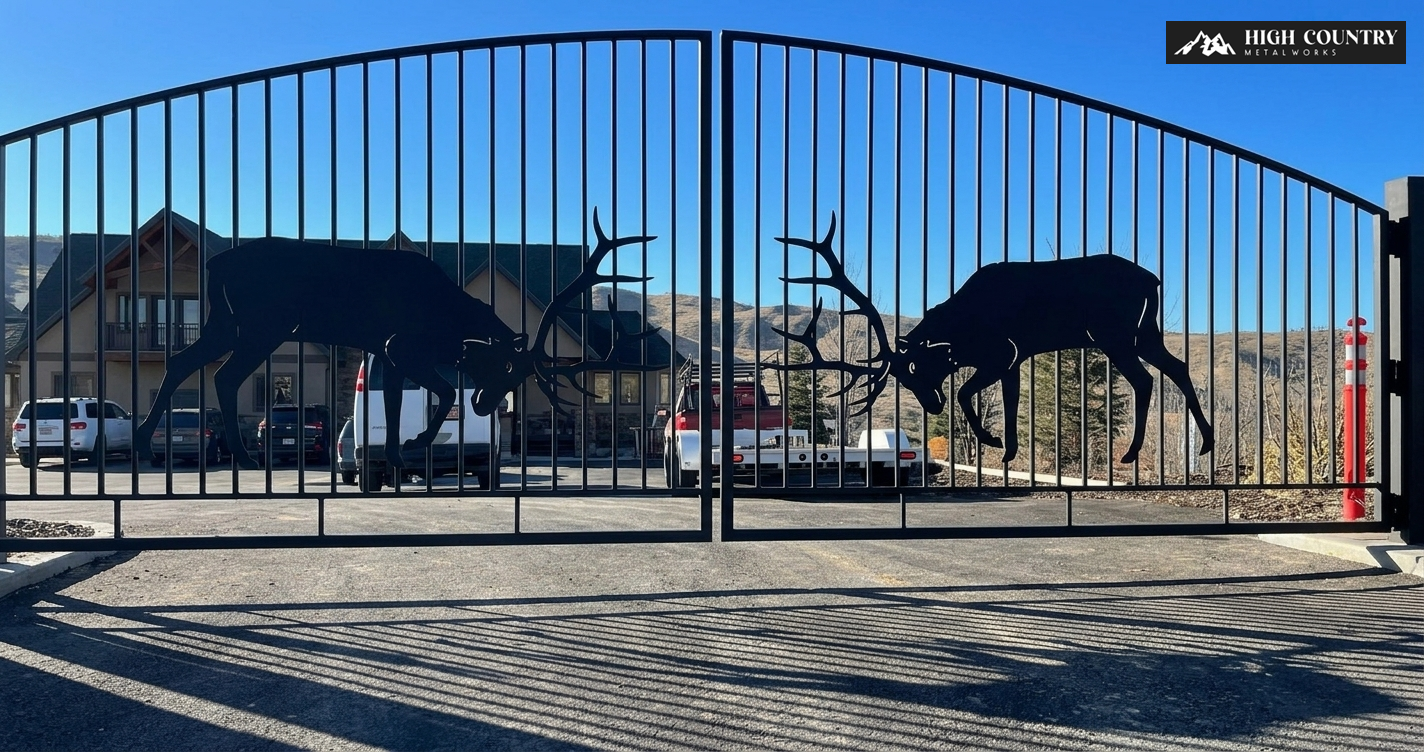
Vertical pickets, scrollwork, finials, and spear tops deliver the look most people picture when they think of estate gates. Open construction keeps sight lines clear, lets wind pass through, and pairs naturally with matching fence sections.
Best for: estate entrances, historic-style homes, and properties where the gate should echo existing ironwork.
Watch for: the label. Much of what is sold today as "wrought iron" is fabricated mild steel in a traditional style. True wrought iron is rare. Ask your fabricator exactly what metal is being used, because it affects cost, weight, and rust behavior. Tighter picket spacing and pointed tops also make a gate harder to climb.
6. Gate With Side Panels and a Walk-Through
A side panel fills the gap between the gate and the property edge, corrects odd opening widths, and gives you a place to mount a keypad, intercom, or camera. Adding a pedestrian gate beside the driveway gate means visitors and family do not need to run the main gate for every trip.
Best for: wide frontages, properties with irregular openings, and owners who want secure foot access.
Watch for: alignment. Panels, pedestrian gates, and fencing should share the same height, picket pattern, and finish, or the entrance looks pieced together.
For larger properties, a gate can also be designed as part of a broader custom metal fencing system so the gate, posts, fence panels, and decorative elements have a consistent appearance and structural design.
7. Laser-Cut Decorative Panel Gate
Patterns are cut directly into steel or aluminum plate: monograms, mountain silhouettes, geometric grids, or botanical designs. The result gives privacy with filtered light, and no two gates look alike.
Best for: homeowners who want a signature design and a gate that reads as art.
Watch for: edges and thin sections. Very fine patterns weaken the panel, and cut edges need full coating coverage so rust does not start there first.
How Metal Gate Materials Compare
Three metals cover nearly every residential gate. The right one depends on security needs, upkeep tolerance, and the weight your hardware can handle.
Steel is the strongest option for metal gates for driveways that need maximum security. Aluminum suits metal gates for entryways where low upkeep matters most, and its lighter weight eases strain on hinges and operators. Iron-style gates carry the most traditional detail but ask the most from the owner in rust prevention.
The finish matters as much as the metal. A powder coat applied over properly prepared steel resists chipping and fading far better than field-applied paint. Weld seams, cut edges, and the bottoms of pickets fail first, so ask how those areas are sealed before you approve a quote.
For particularly large or heavy gates, steel load calculations can also help determine whether the selected posts, structural components, and supporting elements are appropriately sized for the expected loads.
Automation, Access Control, and Safety
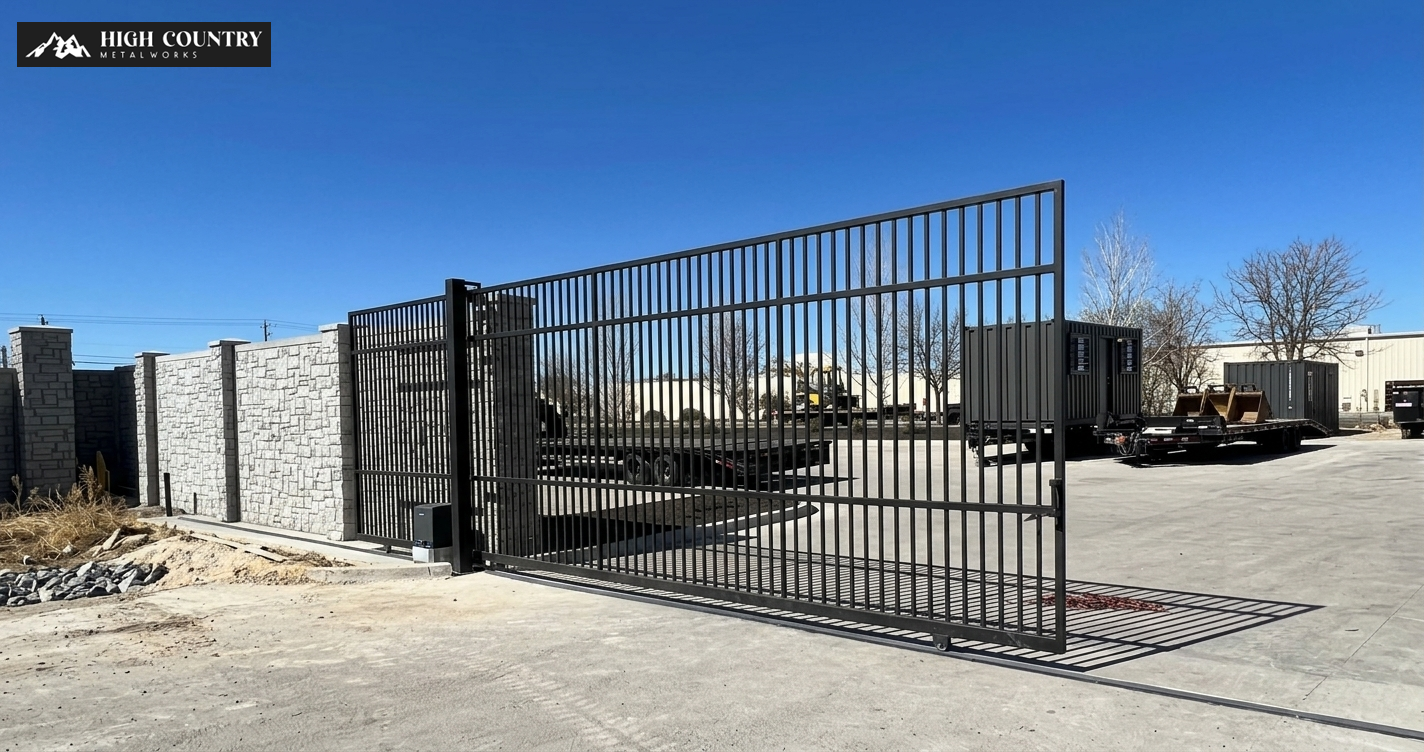
Most owners of larger gates add an automatic opener, and that changes the design conversation. The operator must be matched to the gate's weight, length, and daily cycle count. An undersized operator wears out early, and an oversized one adds cost without benefit.
Safety is not optional. The UL 325 standard for gate operators requires at least two independent entrapment protection devices for each entrapment zone, such as photo eyes combined with contact edges. Professional installers wire these devices in and test them, which is one reason automation is not a weekend project.
Beyond the opener, consider the following access options:
Keypads or coded entry for family and service providers
Intercoms and camera integration for deliveries
Remote or phone-based controls for daily use
Battery backup and a manual release so the gate still opens during a power outage
Planning Checklist Before You Order
A short planning pass prevents the most expensive mistakes. Measure the opening at several points, not just once, since driveways rarely run perfectly square. Note the grade across the full swing or slide path, and mark where snow piles up in winter.
Next, check with your homeowners association and local building office. Gate height, setback, and material rules vary widely, and a gate that violates them can be ordered removed. Confirm where underground utilities run before any post holes are dug. Finally, decide the privacy level and access method before design begins, since both change the structure of the gate.
Installation and Maintenance That Make a Gate Last
Stability starts below ground. Posts belong in properly sized concrete footings, paired with corrosion-resistant fasteners that resist loosening from moisture and temperature swings. Sagging and misalignment usually trace back to undersized footings or hinges, not the gate panel.
Climate decides how aggressive your upkeep should be. In areas with freeze-thaw cycles, shifting soil can nudge posts out of plumb, so check post stability each spring once the ground settles. In sunny climates, choose UV-stable coatings to slow fading.
A simple seasonal rhythm keeps most gates performing for decades:
Inspect twice yearly for loose hardware, rust spots, and hinge wear
Clean annually to remove grime, salt residue, and organic buildup
Recoat every three to five years to refresh protective finishes
Catching a small rust spot or a loose bolt early costs a fraction of what a repair after a failure costs.
Conclusion
The right custom metal gate balances movement, privacy, material, and finish against the real conditions of your property. Start with the site, choose the style that fits it, and build with posts and hardware sized for the load. Contact High Country Metal Works to talk through your driveway or entryway and request a custom quote.
FAQ
1. What are the most popular custom metal gate styles?
The most popular custom metal gate styles are double swing gates, cantilever slide gates, horizontal slat privacy gates, and ornamental picket gates. Swing and slide describe how a gate moves, while slat, picket, and panel describe its look.
2. What is the best material for metal gates for driveways?
Steel is the best choice for metal gates for driveways that need maximum strength and security. Aluminum is better when low maintenance and lighter weight matter more.
3. Are swing gates or slide gates better for sloped driveways?
Slide gates, especially cantilever designs, usually handle slopes better because they do not sweep an arc across rising ground. A swing gate can still work if the hinges and gate bottom are designed for the grade.
4. How much do custom metal gates cost?
Cost depends on gate size, material, design complexity, finish, and automation. A written quote based on a site measurement is the only reliable way to price a custom gate.
5. What is the best style for metal gates for entryways?
A single swing gate in steel or aluminum suits most metal gates for entryways, since it is simple, durable, and easy to match to existing fencing. Add a side panel if the opening is irregular.


