Easy Guide to Stair Riser Height & Stair Tread Depth Standards
The standard stair riser height is a maximum of 7.75 inches, and the minimum stair tread depth is 11 inches. These dimensions are established by the International Residential Code (IRC) and adopted by most state and local building codes across the United States. Uniform riser heights and adequate tread depths are the two most critical factors in stair safety and code compliance.
Key Takeaways
Maximum stair riser height: 7.75 inches per IRC and most state codes
Minimum stair tread depth: 11 inches, with 12 inches preferred by many professionals
All risers within a single flight must be uniform; variation is a leading cause of stair-related falls
Custom metal fabrication delivers precise dimensional control that wood and concrete often can't match
Regular inspections every six months keep metal stairs safe and code-compliant over time
Getting stair dimensions wrong isn't a minor oversight; it's a safety hazard. Whether you're a contractor specifying stairs for a new build or a homeowner retrofitting a deck, understanding the standard stair riser height and minimum tread depth requirements helps protect users and keeps your project code-compliant. This guide breaks down the numbers, explains why they matter, and covers how custom metal stair components can meet and exceed these standards.
What Is the Standard Stair Riser Height?
The stair riser height is the vertical distance from the top of one tread to the top of the next. It directly controls how much effort each step requires and how natural the stair rhythm feels underfoot.
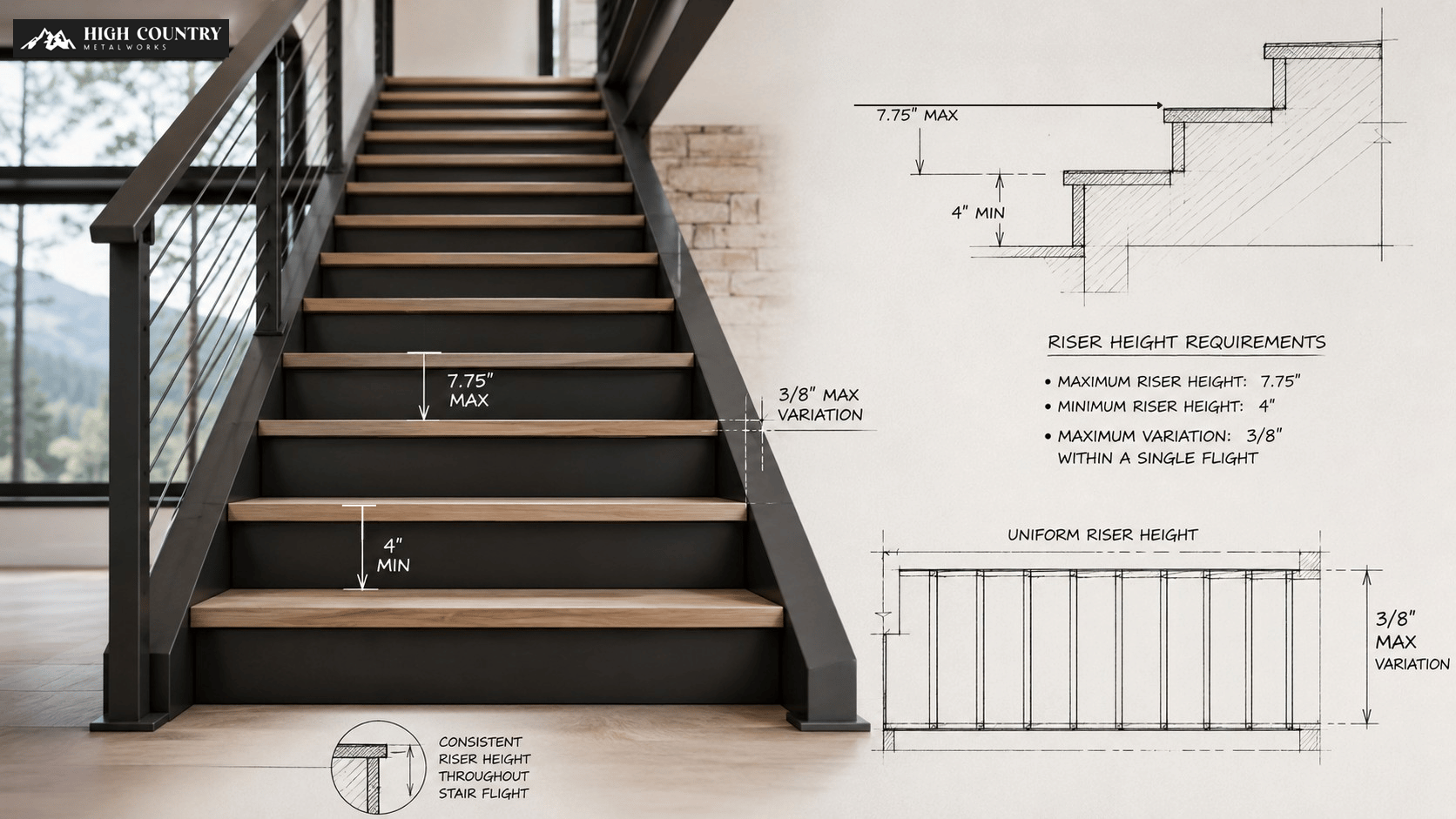
The standard stair riser height under the IRC is a maximum of 7.75 inches. The average stair riser height in residential construction typically falls between 7 and 7.5 inches, a range most users find comfortable without feeling either too flat or too steep. The minimum riser height is 4 inches; anything lower creates a tripping hazard because the step is too shallow for users to perceive clearly.
The ideal stair riser height balances human biomechanics with spatial constraints. Research in ergonomics consistently shows that risers between 6.5 and 7.5 inches produce the most natural gait for adults, reducing fatigue on longer stairways. When risers exceed the maximum, the increased lift per step strains knees and hips, a particular concern in residential applications where elderly users or children may be frequent users.
Stair Riser Height Code Requirements
The stair riser height code most commonly referenced is IRC Section R311.7.5.1. Key provisions include:
Maximum riser height: 7.75 inches
Minimum riser height: 4 inches
Uniformity requirement: The greatest riser height within a single flight of stairs cannot exceed the smallest by more than 3/8 inch
That uniformity requirement is critical. Nonuniform risers, even minor variations that look visually similar, are among the most common causes of stair falls. The human body anticipates a consistent step height once a rhythm is established; an unexpected deviation triggers a stumble. Stair riser height code exists largely to enforce this consistency.
Commercial and public occupancy stairs (governed by the IBC rather than IRC) set a slightly lower maximum at 7 inches, reflecting the higher traffic volumes and greater variability in user populations that those stairs serve.
What Is the Standard Stair Tread Depth?
The tread depth is the horizontal measurement from the front edge (nosing) of one step to the front edge of the step above it, the surface your foot actually lands on.
The minimum stair tread depth under the IRC is 10 inches measured from nosing to nosing, or 11 inches when measured as the clear walking surface (excluding the nosing overhang). In practice, most codes and professionals refer to the 11-inch figure as the effective standard.
The typical stair tread depth in residential construction is 10.5 to 11 inches. The average stair tread depth in commercial applications runs slightly deeper, often 11 to 12 inches, to accommodate heavier foot traffic and a wider range of user foot sizes. Many architects and builders target 12 inches as a preferred depth because it provides better footing for adults and reduces the risk of heel overhang.
Tread Depth and the Riser-Tread Relationship
Riser height and tread depth don't operate independently; they work together through a biomechanical formula that has been validated across decades of building science:
2R + T = 24–25 inches (where R = riser height and T = tread depth)
Using the standard maximum riser of 7.75 inches: 2(7.75) + T = 24–25, which gives a tread depth of 8.5 to 9.5 inches. This formula acts as a cross-check: stairs that satisfy both the individual maximum/minimum values and the combined formula produce the most ergonomically comfortable result.
Maximum Stair Tread Depth
Unlike riser height, most codes do not specify a maximum stair tread depth. Deeper treads are generally safer. The practical constraint is space; a very deep tread extends the overall stair run significantly, which may not be feasible within the building footprint.
Riser Height and Tread Depth at a Glance
Stair Riser Height (IRC): 4–7.75 in, with a typical height of 7–7.5 in.
Stair Riser Height (IBC/Commercial): 4–7 in, with a typical height of 6.5–7 in.
Stair Tread Depth (IRC): Minimum 10 in (nosing-to-nosing) or 11 in (clear), with no maximum; typical depth is 10.5–11 in.
Stair Tread Depth (Commercial): Minimum 11 in, with no maximum; typical depth is 11–12 in.
How Custom Metalwork Elevates Riser and Tread Standards
Wood treads swell, warp, and compress over time, all changes that subtly alter riser heights and create the nonuniformity that codes prohibit. Concrete can be difficult to pour to tight tolerances without skilled formwork. Custom metal fabrication solves both problems.
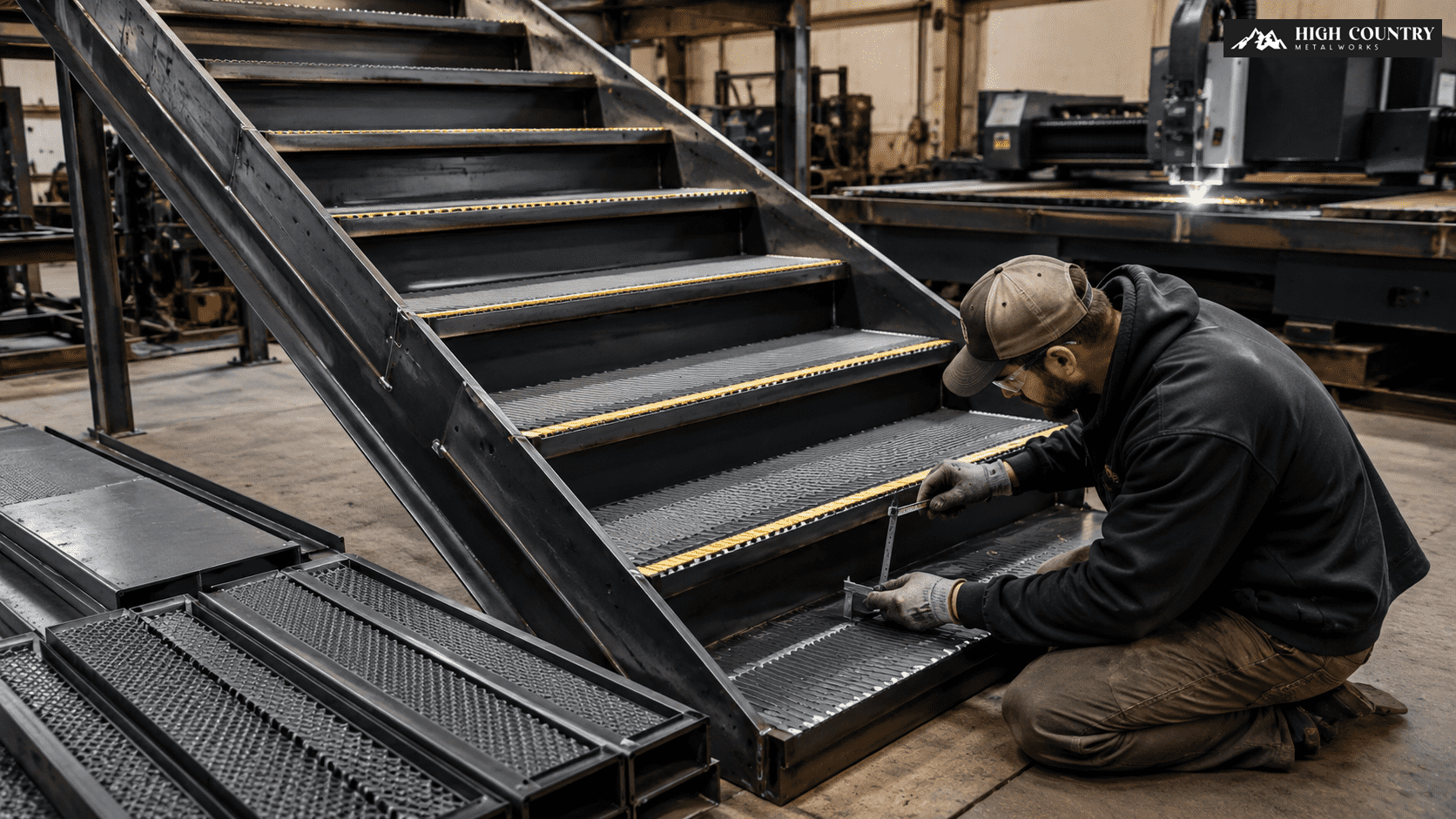
Steel, aluminum, and stainless steel stair components can be cut and formed to tolerances of ±1/16 inch or better, well within the 3/8-inch uniformity requirement. This precision is maintained across an entire flight, not just at the inspection point.
Beyond dimensional accuracy, metal stair components offer functional advantages that directly improve safety:
Slip resistance. Metal treads can be fabricated with integral serrations, checker plate patterns, or abrasive nosing inserts. These features are especially valuable for exterior stairs or any high-traffic application where wet or dusty conditions are likely.
Integrated edge marking. High-contrast nosing strips or paint-filled grooves make tread edges clearly visible, a low-cost safety upgrade that significantly reduces the risk of misjudging a step edge.
Structural longevity. A steel stair that is properly coated or fabricated from corrosion-resistant alloys maintains its dimensions indefinitely. There is no seasonal movement, no creep under load, and no softening from moisture intrusion.
Design flexibility. Custom metalwork accommodates open risers, floating treads, curved flights, and cantilevered designs that would be structurally impractical in wood. This flexibility allows architects and contractors to meet both the aesthetic intent of a project and the dimensional requirements of the applicable code simultaneously.
High Country Metal Works fabricates custom metal stair risers and treads to project specifications, working directly with contractors and designers to confirm that every component meets riser height code and tread depth requirements before installation.
Inspection and Maintenance for Metal Stairs
Correct dimensions at installation are only part of the equation. Metal stairs require periodic inspection to confirm they remain within code tolerances and are structurally sound.
Inspection frequency: For stairs under regular use, a thorough inspection every six months is recommended. High-traffic commercial installations benefit from quarterly checks.
What to inspect:
Verify riser heights and tread depths have not shifted due to settling, fastener loosening, or impact damage
Check all bolts and connection points for tightness. Vibration from foot traffic gradually loosens hardware over time
Inspect welds and surface coatings for cracks, chips, or signs of corrosion
Confirm drainage paths on exterior stairs are clear to prevent water pooling, which accelerates rust and creates slip hazards
Surface maintenance: Clean metal treads regularly to remove debris and contaminants that degrade slip resistance. For carbon steel components, inspect protective coatings annually and recoat as needed before corrosion reaches the base metal. Stainless steel and aluminum installations require less aggressive maintenance but benefit from periodic cleaning with appropriate surface cleaners.
Document each inspection with measurements and photographs. A maintenance record supports code compliance audits and provides evidence of due diligence in the event of an injury claim.
Request a Custom Quote for Metal Stair Risers and Treads
High Country Metal Works provides custom fabrication of metal stair risers, treads, and complete stair assemblies. To request a quote:
Compile your specifications — total rise, number of steps, preferred tread depth, material, and any surface treatment requirements
Contact the team directly: [email protected] | (385) 324-6151 | 144 N Draper Ln, Provo, UT 84601
Review the proposal — all quotes confirm dimensional compliance with applicable codes and include material and fabrication details
Conclusion
Understanding standard stair riser height and stair tread depth requirements is foundational to safe, code-compliant stair construction. The numbers are clear: maximum riser height of 7.75 inches, minimum tread depth of 11 inches, and strict uniformity within each flight. Custom metal fabrication supports compliance by delivering the dimensional precision that other materials struggle to maintain over time.
Contact High Country Metal Works for a custom quote tailored to your project's specifications and applicable code requirements.
Frequently Asked Questions
1. What is the maximum stair riser height allowed by code?
The maximum stair riser height under the IRC is 7.75 inches for residential stairs. Commercial stairs governed by the IBC are limited to 7 inches.
2. What is the minimum stair tread depth for residential stairs?
The IRC requires a minimum of 10 inches nosing-to-nosing, which equates to approximately 11 inches of clear tread depth. Most professionals target 11–12 inches for added stability.
3. Does the height of every stair riser in a flight need to match?
Yes. Code requires that the tallest riser in a flight cannot exceed the shortest by more than 3/8 inch. Nonuniform risers are a primary cause of stair falls.
4. What materials are best for custom metal stair treads?
Aluminum is lightweight and corrosion-resistant, making it well-suited for both indoor and outdoor use. Stainless steel offers high strength with a clean finish. Carbon steel is cost-effective for structural applications but requires a protective coating to prevent rust.
5. How often should metal stairs be inspected for code compliance?
Inspect metal stairs under regular use at least every six months. Check riser heights, tread depths, fastener tightness, and surface condition to confirm everything remains within permitted ranges.


