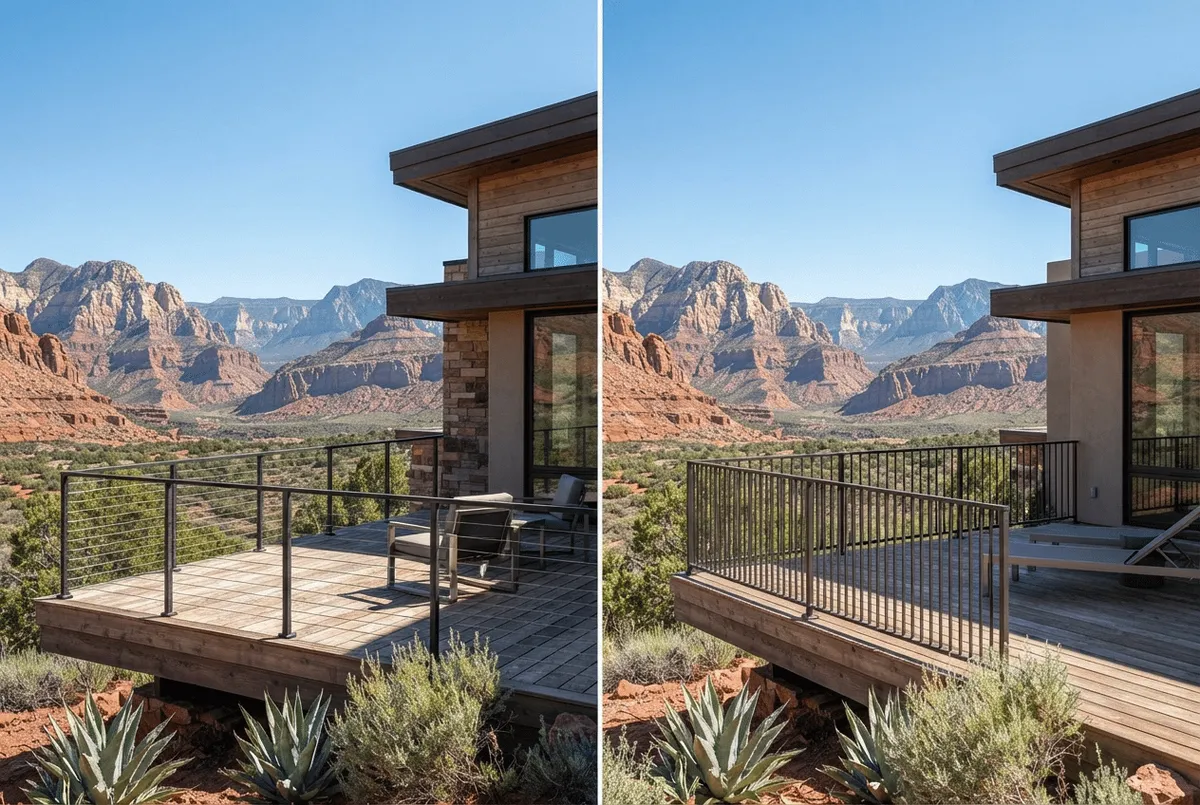
Choosing Between Horizontal & Vertical Metal Railings in Utah
Choosing horizontal vs. vertical metal railings Utah homeowners can trust comes down to one trade-off: views versus child safety. Vertical balusters are the safer, simpler default for families with young children, while horizontal designs suit view-focused decks when the infill is tightly spaced and properly tensioned. Both can meet Utah code, so drop height, sightlines, and winter exposure should decide.
Key Takeaways
Both orientations can pass inspection in Utah. The 4-inch sphere rule governs the infill, not the direction of the bars.
Vertical metal railings remove footholds, which makes them the stronger choice for young children and high drops.
Horizontal metal railings preserve mountain and valley views better than any baluster layout.
Snow performance depends more on bar profile and drainage detail than on orientation alone.
The point where a railing meets your siding, stucco, or stone often decides how long the whole system lasts.
Horizontal vs Vertical Metal Railings Utah: The Core Differences
Horizontal metal railings run bars, rods, or cables between posts, creating long, uninterrupted lines. Vertical metal railings set upright balusters between a top rail and a bottom rail. Both are fabricated from steel or aluminum and can be powder-coated in nearly any color, so the real differences show up in safety, snow behavior, and sightlines.
What Utah Code Requires for Both Styles
Utah adopted the 2021 International Building Code and International Residential Code statewide, according to the International Code Council. The requirements below follow those model codes, so confirm local amendments with your building department before ordering materials.
Guard trigger: a guard is required where the walking surface sits more than 30 inches above grade.
Guard height: at least 36 inches on homes, and generally 42 inches on commercial buildings.
Infill spacing: openings must stop a 4-inch sphere, with 4⅜ inches allowed at stair sides and 6 inches at the stair triangle.
Handrails: 34 to 38 inches above the stair nosings.
Strength: guards must resist a 200-pound concentrated load at the top and a 50-pound load across one square foot of infill.
Orientation itself is not a code violation. The "ladder effect" language that discouraged horizontal rails appeared in the 2000 International Residential Code and was removed in the 2001 supplement, and the International Building Code never carried it. Some local inspectors still weigh climbability, however, so we confirm the infill layout with the building department before fabrication. A phone call costs far less than a failed final inspection, and it settles the question before any metal is cut.
Cable systems deserve a separate warning. A cable that passes the sphere test on the shop floor can fail it in the field if tension relaxes, which is why many manufacturers space cables near 3 inches on center.
Child Safety Favors Vertical Balusters
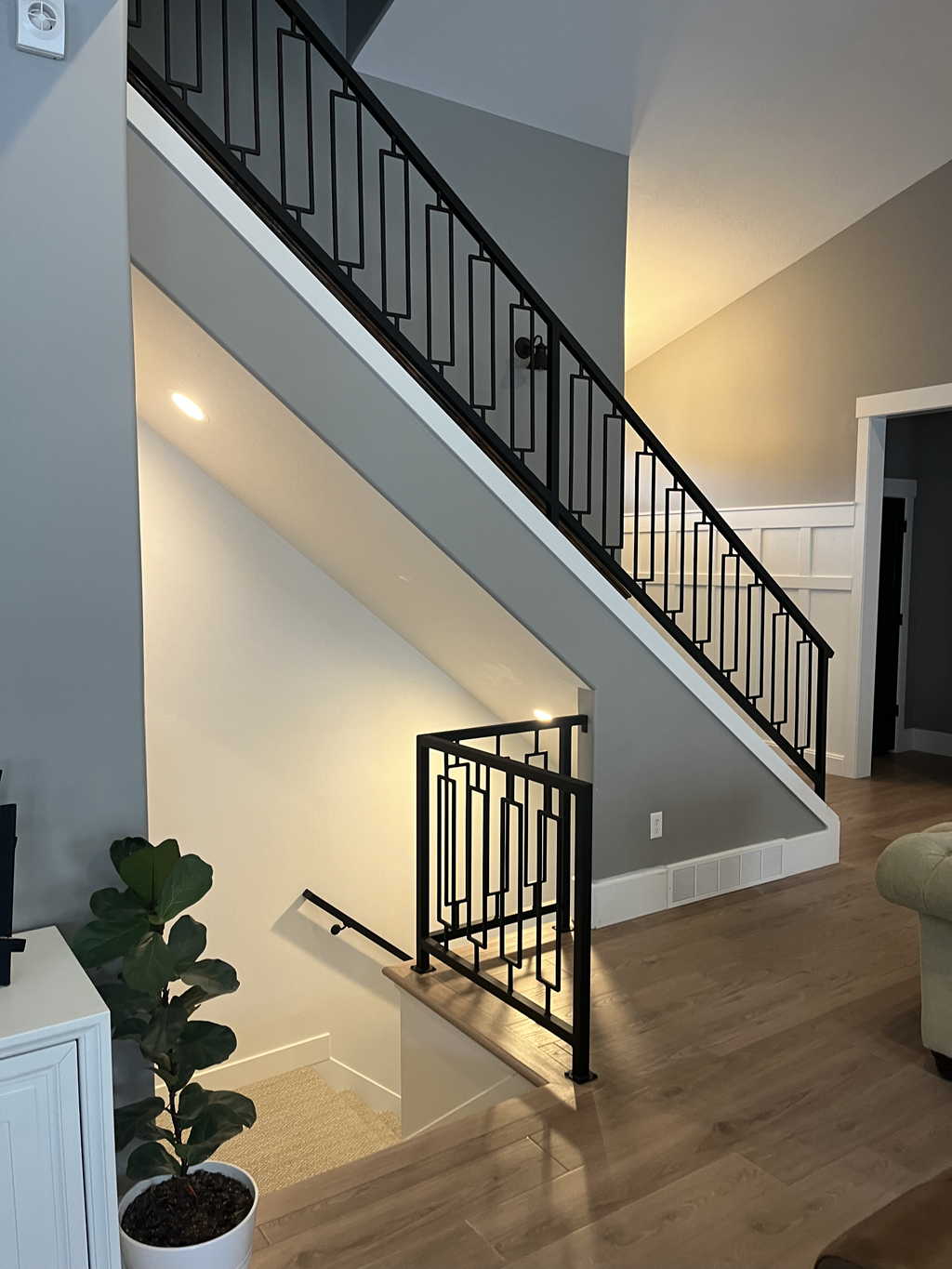
Horizontal railings invite climbing. Research summarized by the International Code Council's Code Technology Committee found that even shallow horizontal projections, spaced about a foot apart, gave some three-year-olds enough purchase to scale a guard.
Our rule of thumb is simple and has held up on exterior projects across Park City and Heber City. If children under six regularly use the space, or the drop is more than one story, choose vertical balusters or vertical cable. If the deck is mostly an adult retreat at a modest height, horizontal metal railings are a reasonable choice, provided the spacing and tension are verified at installation.
Parents and grandparents often tell us the deck is "only used on weekends." Children climb on weekends too, and a railing should be designed for the most vulnerable person who will ever stand beside it.
Snow and Freeze-Thaw Performance Depends on Bar Profile
Most guides claim vertical railings shed snow while horizontal ones trap it. The reality is more specific. Every railing collects snow on its top rail, regardless of orientation. The difference lies in the infill.
Flat horizontal bars create small shelves that hold snow and ice, adding weight at the mounting points.
Round bars and thin cables offer little surface area, so snow slides off or melts through quickly.
Vertical balusters let meltwater run straight down, but water can pool at the bottom rail and base plates if drainage gaps are missing.
Freeze-thaw cycles do the real damage. Water that enters a hollow post or a base plate freezes, expands, and cracks coatings from the inside. We check for weep holes, sealed welds, and proper drainage detailing before we consider style. De-icing salts add a second threat on stairs, accelerating corrosion where coatings have chipped.
For most Utah homes, powder-coated aluminum or hot-dip galvanized steel with a powder-coat topcoat is the durable approach. The finish matters more than the orientation, so ask any fabricator about coating thickness and warranty terms in writing. Higher-elevation properties near Park City face longer winters and stronger ultraviolet exposure, which makes coating quality even more important there than in the valley.
Metal Railing Designs That Preserve Views
Horizontal metal railings deliver the cleanest sightlines for Wasatch Front and Park City decks, where the view is the property's main asset. Vertical balusters at close spacing create a rhythm that the eye can read as a screen, although slim square or round balusters in matte black recede surprisingly well at a distance.
Metal railing designs do not have to be all one orientation. Three hybrids work well in Utah:
Vertical infill with a horizontal top rail, which keeps the safety of balusters and a modern profile.
Horizontal on the upper deck, vertical on the stairs, where falls and small climbers are the greater concern.
Vertical cable with support balusters, which opens the view without creating footholds.
Where Railings Meet Siding, Stucco, and Stone
This is the detail most competitor guides skip, and it is where we spend most of our time. Every post that passes through or mounts to an exterior wall creates a penetration. If flashing, sealant, and blocking are wrong, moisture reaches the framing, and the damage appears years later behind the siding.
Three practices protect the wall:
Anchor posts into the structure, never into stone veneer or stucco alone.
Flash and seal every penetration before the railing is set, not after.
Use stand-off or fascia mounts that keep water from running along the post into the wall.
When a railing is installed during a siding, stucco, or stone project, the same crew can coordinate flashing and finish details in one sequence. That coordination is a practical advantage over hiring a railing fabricator and an exterior contractor separately.
Maintenance Habits That Extend Railing Life
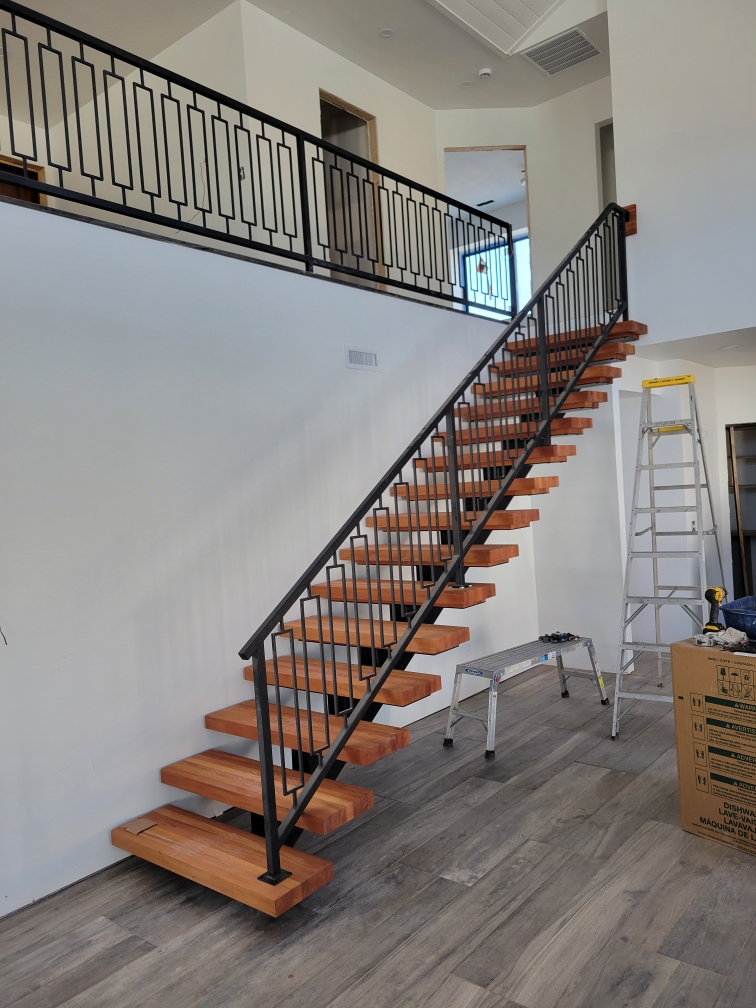
Metal railings Utah homeowners install today should get a short inspection every spring and fall. Check base plates and post bottoms for chipped coating, because bare metal rusts quickly once moisture and de-icing salt reach it. Touch up chips with a matched coating before the next freeze, and rinse stair railings after the salting season ends.
Horizontal cable systems need one extra step. Cables relax with temperature swings and settling, so recheck tension annually and tighten any run that deflects more than the manufacturer allows. Vertical systems need less adjustment, but loose baluster welds or fasteners deserve prompt repair.
A Practical Way to Choose
Work through four questions in order:
Who uses the space? Young children point to vertical.
How high is the drop? A higher drop points to vertical or hybrid designs.
How important is the view? A strong view points to horizontal round bar or cable, correctly tensioned.
How exposed is the location? Heavy snow and salt exposure point to round profiles, drained bases, and quality coatings.
If your answers conflict, a hybrid usually resolves the tension. Bring photos of the space, the drop height, and your view priorities to the estimate, and a clear recommendation can usually follow quickly.
Conclusion
Horizontal metal railings protect the view, and vertical metal railings protect the child. Both can be built to Utah code, and both last when the finish, drainage, and wall connections are done correctly. Sorensen Construction Services can review your property, confirm local requirements, and coordinate the railing with your exterior work.
Request a free, no-obligation estimate to compare options for your home.
Frequently Asked Questions
Are horizontal metal railings allowed in Utah?
Yes. Utah's adopted model codes do not prohibit horizontal infill, but it must stop a 4-inch sphere, and some local inspectors review climbability, so confirm with your building department.
How high must a deck railing be in Utah?
Residential guards must be at least 36 inches high on walking surfaces more than 30 inches above grade. Commercial guards are generally 42 inches.
Which metal railing style is safer for young children?
Vertical metal railings are safer because upright balusters offer no footholds. Vertical cable with support balusters is a good option when you want a more open view.
Do horizontal railings hold more snow than vertical railings?
Flat horizontal bars hold more snow than round bars, cables, or vertical balusters. Every railing collects snow on its top rail regardless of style.
What is the 4-inch sphere rule for metal railings?
A 4-inch sphere must not pass through any opening in a guard's infill. Stair sides allow 4⅜ inches, and the stair triangle allows 6 inches.


