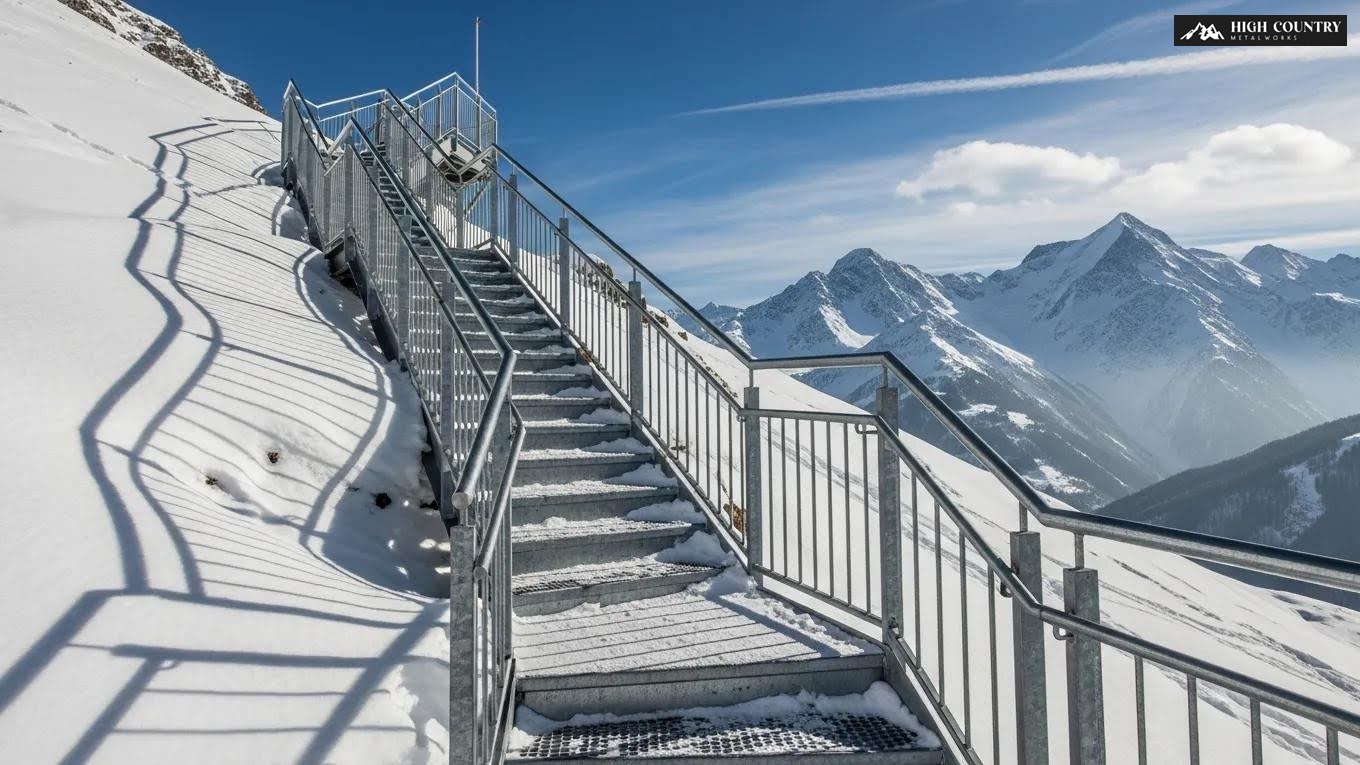
Why Galvanized Steel Staircases Are Ideal for Alpine Conditions
Galvanized steel staircases are ideal for alpine conditions because the hot-dip zinc coating provides sacrificial corrosion protection against snowmelt, ice, and freeze–thaw cycles. They retain structural strength across extreme temperature swings, require minimal maintenance, and deliver a service life of 30–50 years, outperforming timber, aluminum, and uncoated steel in mountain environments.
Key Takeaways
Zinc coating = long-term protection — Hot-dip galvanization bonds a zinc-iron alloy layer to steel, providing sacrificial corrosion resistance that self-protects even when scratched or chipped.
Built for freeze–thaw abuse — Galvanized steel maintains load-bearing strength across extreme alpine temperature swings that crack, warp, or delaminate competing materials.
Custom vs. prefabricated — Custom staircases suit complex terrain and strict code requirements; prefabricated systems offer faster installation and lower upfront cost for straightforward alpine projects.
Installation details matter — Footings must reach below frost depth (36–48 inches in Utah highlands), and tread drainage must be designed to prevent ice accumulation at the base.
Low-maintenance advantage — Annual inspection, prompt snow removal with non-metallic tools, and periodic zinc touch-up are all that's needed to sustain a 30–50 year service life.
Meets alpine code standards — Hot-dip galvanized steel satisfies ASTM A123 and A153 specifications and supports IBC/IRC compliance for high snow load environments exceeding 150 psf.
Best material for mountain homes — Across 10–15-year project histories in Utah's alpine communities, galvanized steel staircases consistently outperform all alternative materials in durability and cost of ownership.
Homeowners, architects, and builders working in alpine environments face a recurring structural challenge: finding stair solutions that withstand heavy snowfall, relentless freeze–thaw cycles, and corrosive moisture year after year. After more than a decade of fabricating and installing metalwork across Utah's high-country communities, we at High Country Metal Works consistently recommend galvanized steel staircases for alpine settings above every other material option.
This guide covers why galvanization defines alpine stair durability, how custom galvanized steel staircases compare to prefabricated systems, what proper installation and maintenance look like in cold climates, and which safety standards govern these structures in mountainous areas.
What Makes Galvanized Steel Ideal for Alpine Stair Systems?
Alpine environments place extreme demands on outdoor structures. Temperatures swing from below zero to above freezing within a single day. Snowmelt and ice accumulation introduce constant moisture, and UV exposure at altitude accelerates surface degradation. Most materials, such as untreated steel, aluminum, and timber, cannot sustain structural performance under all of these stressors simultaneously.
Galvanized steel staircases for alpine applications succeed where others fail because galvanization fuses a metallurgical zinc coating directly to the steel substrate. This is not a surface paint; it is a bonded zinc-iron alloy layer that resists abrasion, moisture intrusion, and atmospheric corrosion at a microscopic level. The result is a corrosion-resistant steel staircase that maintains structural integrity and visual quality across decades of high-altitude service.
Key performance properties include:
Sacrificial zinc protection: Zinc corrodes preferentially over the base steel, protecting the structure even when the coating is scratched.
Thermal stability: Galvanized steel retains load-bearing strength across the temperature ranges typical of alpine environments.
Impact and load resistance: Steel handles snow loads, foot traffic, and incidental impacts that would crack or delaminate alternative materials.
Low lifecycle cost: Higher upfront cost is offset by significantly reduced maintenance and a service life measured in decades.
How Does Galvanization Prevent Corrosion in Snowy Mountain Environments?
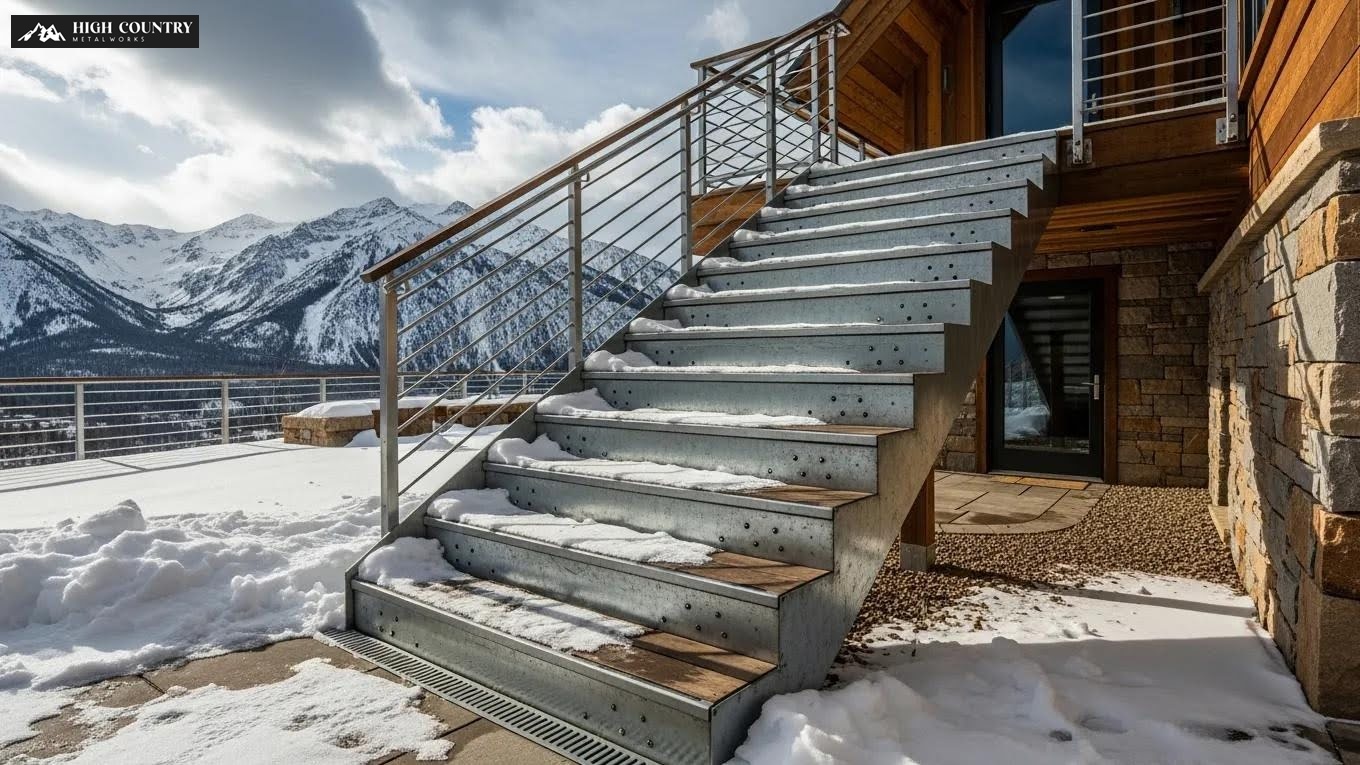
The hot-dip galvanization process submerges fabricated steel in molten zinc at approximately 450°C (840°F), producing a series of zinc-iron alloy layers topped by a pure zinc outer layer that is chemically bonded to the steel rather than adhering to its surface.
In snowy alpine conditions, where road salt and acidic meltwater are common, this bonded zinc layer functions as a continuous electrochemical barrier. When the coating is compromised, zinc ions migrate cathodically to protect nearby exposed steel, a property known as sacrificial or cathodic protection. Small areas of damage do not propagate into wider corrosion, which is critical in environments where inspection and touch-up work are difficult during winter months.
For corrosion-resistant steel staircases in Utah's mountain communities, we specify hot-dip galvanized steel as the baseline standard, with coating thickness selected to match each site's specific elevation, aspect, and moisture exposure.
Custom vs. Prefabricated Galvanized Steel Staircases for Alpine Use
Both custom galvanized steel staircases for alpine projects and prefabricated galvanized steel staircase systems serve legitimate roles. Selecting the right approach depends on site geometry, architectural requirements, budget, and timeline.
Custom Galvanized Steel Staircases
Custom fabrication is appropriate when the site presents irregular terrain, unique architectural integration, or non-standard dimensions. At High Country Metal Works, we engineer custom mountain staircases from initial site measurement through final installation, every tread depth, stringer angle, and landing dimension matched precisely to the location.
Advantages of custom metal staircases in alpine environments include geometry tailored to exact slope gradients, integration of non-slip tread surfaces and drainage channels designed for site-specific snow and ice exposure, full compliance with local building codes and engineered snow load calculations, and visual continuity with the home's architectural character.
Prefabricated Galvanized Steel Staircases
A prefabricated galvanized steel staircase is produced in a controlled manufacturing environment and assembled on site from standardized components. For straightforward projects, secondary access stairs, utility entries, or installations where dimensional flexibility is not required, prefabricated systems offer faster installation and lower upfront cost.
Features:
Design Flexibility:
Custom galvanized steel offers high flexibility because it is engineered specifically for the site, while prefabricated galvanized steel uses standard modules with limited customization.
Durability:
Custom galvanized steel provides high durability. Prefabricated galvanized steel also performs well but typically offers moderate to high durability, depending on the application.
Installation Speed:
Custom galvanized steel installations usually take a moderate amount of time due to custom fabrication and fitting. Prefabricated galvanized steel installs faster because the components are pre-made.
Upfront Cost:
Custom galvanized steel generally comes with a higher initial investment, whereas prefabricated galvanized steel is more budget-friendly upfront.
Long-Term Value:
Custom galvanized steel delivers the highest long-term value because of its tailored design and durability. Prefabricated galvanized steel still offers good value for simpler projects and applications.
Installation Best Practices for Alpine Steel Stair Systems
Correct installation is as important as material selection. A well-fabricated galvanized steel staircase installed on an inadequate foundation or without proper drainage detailing will underperform regardless of coating quality.
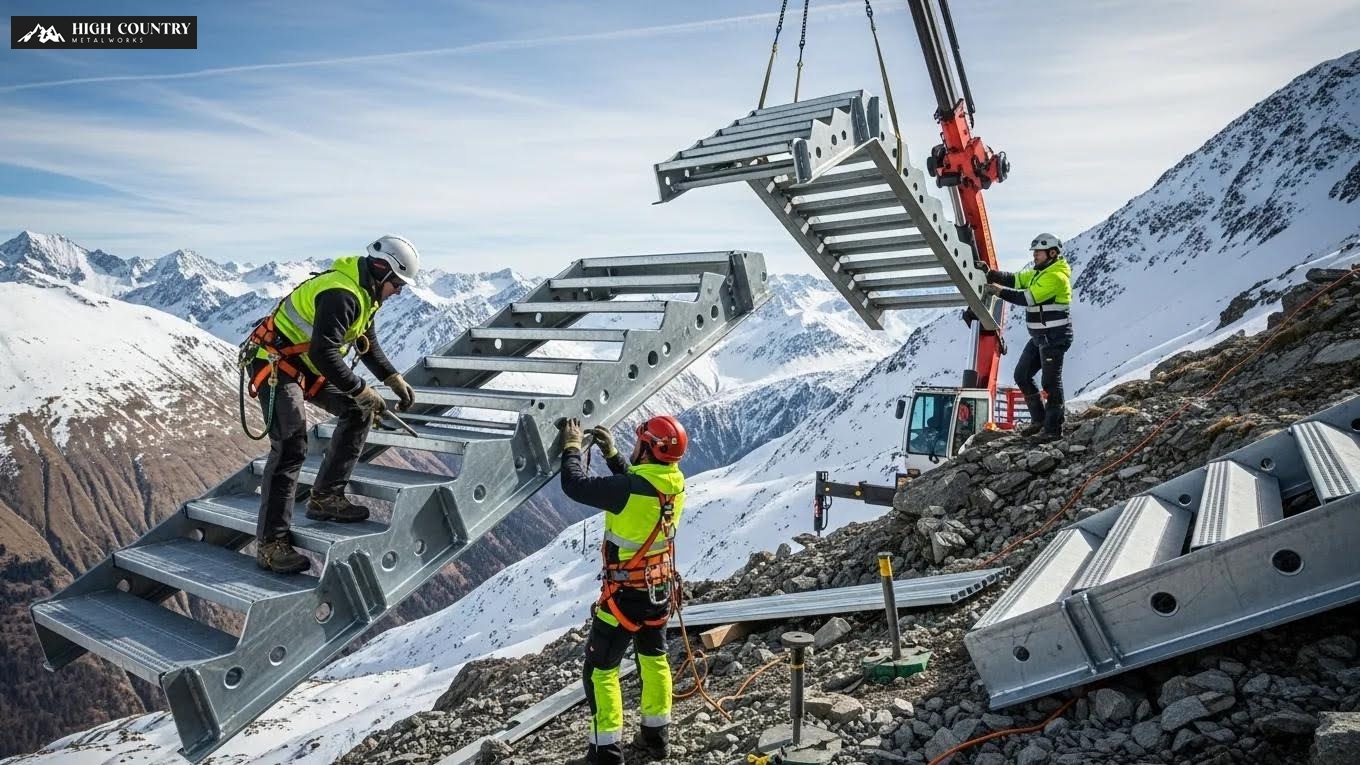
1. Foundation and anchoring
Alpine soils are subject to significant frost heave. Footings must extend below the local frost depth in Utah's higher elevations, typically 36 to 48 inches. Anchor bolts and base plates should be stainless steel or hot-dip galvanized to prevent galvanic corrosion at the connection point.
2. Drainage design.
Water must be directed away from the stair structure and its foundation. Open-bar or perforated grating treads allow snow and meltwater to pass through rather than accumulate. Landing surfaces should slope a minimum of 2% away from the structure to prevent ice formation at the base.
3. Tread surface treatment
Treads in alpine applications should incorporate aggressive non-slip profiles, serrated bar grating, nosing with abrasive inserts, or bolt-on anti-slip strips to prevent ice accumulation from becoming a slip hazard beyond what the galvanized coating alone provides.
Maintaining Galvanized Steel Staircases in Cold Mountain Climates
One of the primary advantages of weather-resistant outdoor steel stairs is reduced maintenance demand compared to timber or unprotected metal. A proactive schedule extends service life and prevents minor issues from becoming structural problems.
Annual inspection should be conducted in late autumn before the first snowfall. Inspect the zinc coating for chips, scratches, or areas of white rust, indicating moisture is reaching the coating. Check welds, connections, and anchor points for cracking or movement.
Snow and ice management. Remove heavy snow accumulations promptly using non-metallic tools to avoid scratching the zinc coating. Avoid calcium chloride de-icers at high concentrations, which can accelerate zinc corrosion. Sand provides safer traction on galvanized surfaces.
Touch-up coating. Small areas of damage can be repaired using cold galvanizing compound, a high-zinc-content paint formulated for field repair of hot-dip galvanized surfaces. Address damage promptly to prevent red rust from establishing.
Safety and Building Code Standards for Alpine Steel Staircases
Outdoor galvanized steel staircases in alpine environments are governed by the International Building Code (IBC) and International Residential Code (IRC), with local amendments addressing conditions such as snow loads and seismic requirements specific to Utah mountain jurisdictions.
Key code provisions affecting alpine stair design include snow load calculations in Utah's Wasatch Range, where ground snow loads can exceed 150 psf, requiring structural members to be sized accordingly by a licensed engineer. Handrail requirements specify heights of 34–38 inches measured vertically from the tread nosing. Non-slip tread surfaces are required for all exterior stairs, and alpine conditions demand performance that exceeds minimum code thresholds. For material specifications, hot-dip galvanized steel meets the requirements of ASTM A123 for structural shapes and ASTM A153 for hardware and fittings.
All High Country Metal Works custom stair projects are reviewed by licensed structural engineers and verified for compliance with applicable local codes before fabrication begins.
Galvanized Steel Staircase Performance in Utah's Mountain Communities
High Country Metal Works has fabricated and installed galvanized steel stair systems across Utah's alpine communities from Park City and Deer Valley to the Heber Valley and communities surrounding Brian Head. Consistent findings across our installed projects confirm that staircases built with hot-dip galvanized components and proper drainage detailing show no structural deterioration after 10–15 years of alpine service.
Clients who maintain a simple annual inspection schedule report virtually no corrosion-related issues over the structure's life. Those who replaced previously installed timber or uncoated steel stairs with galvanized systems consistently report reduced annual maintenance time, lower long-term costs, and greater confidence in structural safety during winter conditions.
Conclusion
For outdoor stair systems in alpine and mountain environments, galvanized steel staircases deliver corrosion resistance, structural strength, design flexibility, and long-term value that no alternative material matches. Whether the project calls for custom galvanized steel fabrication tailored to challenging mountain terrain or an efficient prefabricated galvanized steel staircase for a standard installation, investing in quality hot-dip galvanized components ensures reliable, low-maintenance access through decades of alpine winters.
High Country Metal Works designs, fabricates, and installs galvanized steel stair systems for mountain homes and commercial properties throughout Utah. Contact our team to discuss your project and receive a site-specific assessment.
Frequently Asked Questions
1. Is a galvanized steel staircase suitable for year-round outdoor use in alpine climates?
Yes. The zinc coating resists moisture, freeze–thaw cycling, and UV degradation, making hot-dip galvanized steel more durable in cold mountain environments than timber, aluminum, or uncoated steel.
2. How long does a galvanized steel staircase last in snowy conditions?
A properly installed and maintained hot-dip galvanized steel staircase typically lasts 30–50 years or more in alpine conditions, depending on coating thickness, site exposure, and maintenance frequency.
3. Can galvanized steel staircases be painted or powder-coated for custom colors?
Yes. Paint or powder coat formulated specifically for galvanized metal can be applied for color customization. Inspect the finish periodically for chips and touch up promptly to prevent moisture ingress.
4. What is the difference between hot-dip galvanized and electrogalvanized steel for outdoor stairs?
Hot-dip galvanizing produces a thicker, metallurgically bonded coating (typically 3–6 mils) far better suited to long-term alpine exposure than electrogalvanizing (under 1 mil), which is intended for interior or light-exposure applications only.
5. How do I choose between custom and prefabricated galvanized staircases for my mountain home?
Choose custom fabrication for irregular terrain, unique architectural requirements, or strict code compliance needs. Choose prefabricated for straightforward configurations where standard dimensions fit the site and budget is the primary constraint.


